I Deployed My First Smart Contract in an Afternoon
I’d been meaning to learn how smart contracts actually work for a while. Not “how to use OpenZeppelin” or “how to deploy with Remix” — how they work. What’s in an ERC-20. What happens when you deploy. What gas fees are paying for.
So I sat down and did it from scratch: a hand-rolled ERC-20 token, deployed to Ethereum mainnet, with a live Uniswap liquidity pool. This is that walkthrough.
What is an ERC-20?
ERC-20 is a standard interface for fungible tokens on Ethereum. “Fungible” means every unit is identical — one VIBE is the same as any other VIBE, the same way every dollar bill is interchangeable.
The standard defines a handful of functions every compliant token must implement. That’s it. There’s no magic — it’s just a convention that wallets and exchanges know how to talk to.
The Contract
No OpenZeppelin. I wanted to see every line.
// SPDX-License-Identifier: MIT
pragma solidity ^0.8.20;

contract VibeToken {
    string public name = "VibeToken";
    string public symbol = "VIBE";
    uint8 public decimals = 18;
    uint256 public totalSupply;

    address public owner;

    mapping(address => uint256) public balanceOf;
    mapping(address => mapping(address => uint256)) public allowance;

    event Transfer(address indexed from, address indexed to, uint256 value);
    event Approval(address indexed owner, address indexed spender, uint256 value);

    modifier onlyOwner() {
        require(msg.sender == owner, "not owner");
        _;
    }

    constructor() {
        owner = msg.sender;
        totalSupply = 1_000_000 * 10 ** decimals;
        balanceOf[msg.sender] = totalSupply;
        emit Transfer(address(0), msg.sender, totalSupply);
    }

    function transfer(address to, uint256 amount) public returns (bool) {
        require(balanceOf[msg.sender] >= amount, "insufficient balance");
        balanceOf[msg.sender] -= amount;
        balanceOf[to] += amount;
        emit Transfer(msg.sender, to, amount);
        return true;
    }

    function approve(address spender, uint256 amount) public returns (bool) {
        allowance[msg.sender][spender] = amount;
        emit Approval(msg.sender, spender, amount);
        return true;
    }

    function transferFrom(address from, address to, uint256 amount) public returns (bool) {
        require(balanceOf[from] >= amount, "insufficient balance");
        require(allowance[from][msg.sender] >= amount, "insufficient allowance");
        allowance[from][msg.sender] -= amount;
        balanceOf[from] -= amount;
        balanceOf[to] += amount;
        emit Transfer(from, to, amount);
        return true;
    }

    function mint(address to, uint256 amount) public onlyOwner {
        totalSupply += amount;
        balanceOf[to] += amount;
        emit Transfer(address(0), to, amount);
    }

    function burn(uint256 amount) public {
        require(balanceOf[msg.sender] >= amount, "insufficient balance");
        balanceOf[msg.sender] -= amount;
        totalSupply -= amount;
        emit Transfer(msg.sender, address(0), amount);
    }
}
A few things that surprised me coming from traditional software:
Balances are just a mapping. There’s no “token” object anywhere. The entire ledger is mapping(address => uint256) public balanceOf — a hash map from wallet address to balance. When you “send” tokens, you’re just decrementing one entry and incrementing another.
address(0) is the null address. Minting emits a Transfer from address(0) — the convention for “these tokens came from nowhere.” Burning emits a Transfer to address(0) — “these tokens went nowhere.” Wallets and explorers use this to display mint/burn events correctly.
The approve + transferFrom pattern. This is how DEXes work. You can’t let a contract move your tokens without your permission, so you first approve an allowance, then the contract calls transferFrom to pull exactly that amount. Two transactions, but atomic safety.
modifier is a function wrapper. The onlyOwner modifier is reusable access control — _; means “run the function body here.” Any function tagged onlyOwner rejects callers who aren’t the deployer. Mint is dangerous (creates money from nothing), so it gets this guard.
The Tooling
I used Hardhat to compile and deploy. Hardhat gives you a local EVM for testing, a task runner for deployment scripts, and a plugin ecosystem for verification.
A few friction points worth documenting:
Hardhat 3 + Node.js 25 has a broken HTTP client. The compiler downloader uses a fetch implementation that fails with UNABLE_TO_GET_ISSUER_CERT_LOCALLY on Node 25. The fix: NODE_EXTRA_CA_CERTS=/etc/ssl/cert.pem points Node at macOS’s system cert store. Add it to your shell profile and forget about it.
You need an RPC endpoint. Deploying to Sepolia means talking to an Ethereum node. I used Alchemy’s free tier — create an app, select Ethereum Sepolia, copy the HTTPS URL into .env.
You need testnet ETH. Gas fees on testnet are paid in fake ETH. Most faucets have gatekeeping (minimum mainnet balance, social login, etc.). The Google Cloud faucet at cloud.google.com/application/web3/faucet/ethereum/sepolia worked without friction — just a Google account.
Deployment
The deployment script is minimal:
const hre = require("hardhat");

async function main() {
  const [deployer] = await hre.ethers.getSigners();
  console.log("Deploying with account:", deployer.address);

  const VibeToken = await hre.ethers.getContractFactory("VibeToken");
  const token = await VibeToken.deploy();
  await token.waitForDeployment();

  console.log("VibeToken deployed to:", await token.getAddress());
}

main().catch((err) => { console.error(err); process.exit(1); });
npx hardhat run scripts/deploy.js --network sepoliaOutput:
Deploying with account: 0xf8C4795DFdaAC904CF2a380e3599a628E902C653
VibeToken deployed to: 0x2B2FD8fDdcca4247a1f0370c0F26Dae91648d2F1
That contract is now permanent. Anyone can call it. The 1,000,000 VIBE tokens exist in my wallet. The whole thing cost roughly 0.001 Sepolia ETH in gas.
Testing
Tests run locally against Hardhat’s in-process EVM — no testnet, no waiting, no gas.
it("owner can mint new tokens", async function () {
  await token.mint(alice.address, ethers.parseUnits("500", 18));
  expect(await token.balanceOf(alice.address)).to.equal(ethers.parseUnits("500", 18));
  expect(await token.totalSupply()).to.equal(ethers.parseUnits("1000500", 18));
});

it("non-owner cannot mint", async function () {
  await expect(
    token.connect(alice).mint(alice.address, 1)
  ).to.be.revertedWith("not owner");
});
getSigners() gives you fake funded accounts. token.connect(alice) sends transactions as Alice. revertedWith asserts the require message. Nine tests, under a second.
The loop is: write contract → test locally → deploy to testnet when confident. The testnet deployment is the last step, not the first.
Listing on Uniswap
Deploying a token is one thing. Making it tradeable is another.
Uniswap is a decentralized exchange — no company, no order book, no account. It’s a set of smart contracts anyone can interact with directly. The core primitive is the liquidity pool: a contract holding two tokens that lets anyone swap between them. The price adjusts automatically based on a constant product formula (x * y = k). When you buy VIBE, you’re adding ETH and removing VIBE from the pool, which shifts the ratio and raises the price.
To create a VIBE/ETH pool, I wrote a script that does four things:
1. Wrap ETH → WETH. Uniswap only works with ERC-20 tokens. Raw ETH isn’t an ERC-20, so you wrap it first. WETH is just ETH with a deposit()/withdraw() interface — 1 WETH is always redeemable for 1 ETH.
2. Approve the position manager. Uniswap’s contracts need permission to pull tokens from your wallet. This is the approve + transferFrom pattern from the contract — it applies here too. You approve the Uniswap NonfungiblePositionManager to spend your WETH and VIBE.
3. Create and initialize the pool. The pool doesn’t exist until someone creates it. You pick a fee tier (0.3% is standard) and set the starting price — expressed as sqrtPriceX96, which is sqrt(token1/token0) * 2^96. I set it so 1 ETH = 1,000,000 VIBE, which is arbitrary on testnet but determines where trading starts.
4. Mint a liquidity position. You deposit both tokens into the pool and receive an NFT representing your share. Uniswap v3 uses “concentrated liquidity” — you can choose a price range to earn fees in. I used full range (equivalent to Uniswap v2 behavior) to keep it simple.
const tx = await positionManager.mint({
  token0,
  token1,
  fee: 3000,
  tickLower: -887220,  // full range
  tickUpper: 887220,
  amount0Desired: amount0,
  amount1Desired: amount1,
  amount0Min: 0,
  amount1Min: 0,
  recipient: signer.address,
  deadline: Math.floor(Date.now() / 1000) + 60 * 20,
});
The pool went live at transaction 0xed4184b73e9848ede46622b4c2afdf392220c94a6b8509ab31ebd400af75ef44.
The First Swap
Once the pool existed, I went to app.uniswap.org, switched MetaMask to Sepolia, enabled testnet mode in the Uniswap settings, and pasted the VIBE contract address into the token selector.
Swapped 0.0001 ETH for VIBE. It worked.
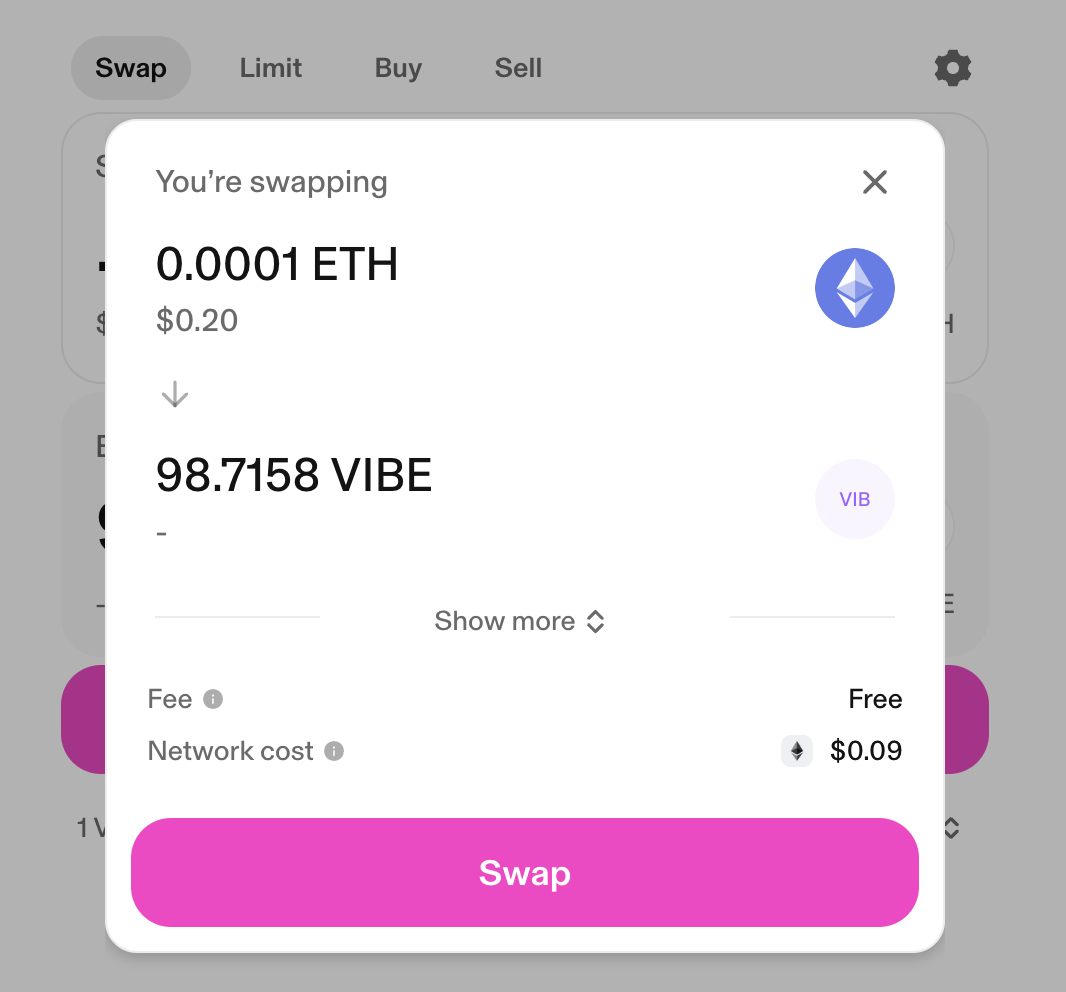
What happened under the hood: Uniswap’s router called approve on my behalf, then called transferFrom on the VIBE contract to move tokens out of the pool and into my wallet. The same two functions I wrote by hand earlier in the day.
The price moved slightly after the swap — the pool now has slightly less VIBE and slightly more ETH, so the ratio shifted. That’s the AMM doing its job.
Going to Mainnet
Once everything worked on Sepolia, mainnet was anticlimactic — exactly as it should be.
Added a mainnet network to hardhat.config.js, pointed it at an Alchemy mainnet RPC, and ran the same deploy script:
npx hardhat run scripts/deploy.js --network mainnetGas was 0.165 Gwei. The whole deployment cost $0.40.
VibeToken deployed to: 0x4d5007d5717795331e8b21b3cd584f7bfe505926Verified on Etherscan:
NODE_EXTRA_CA_CERTS=/etc/ssl/cert.pem npx hardhat verify --network mainnet 0x4d5007d5717795331e8b21b3cd584f7bfe505926Then ran the same liquidity script against mainnet — seeded the pool with 0.01 ETH and 10,000 VIBE. VIBE is now tradeable by anyone on Uniswap mainnet.
Contract: 0x4d5007…505926
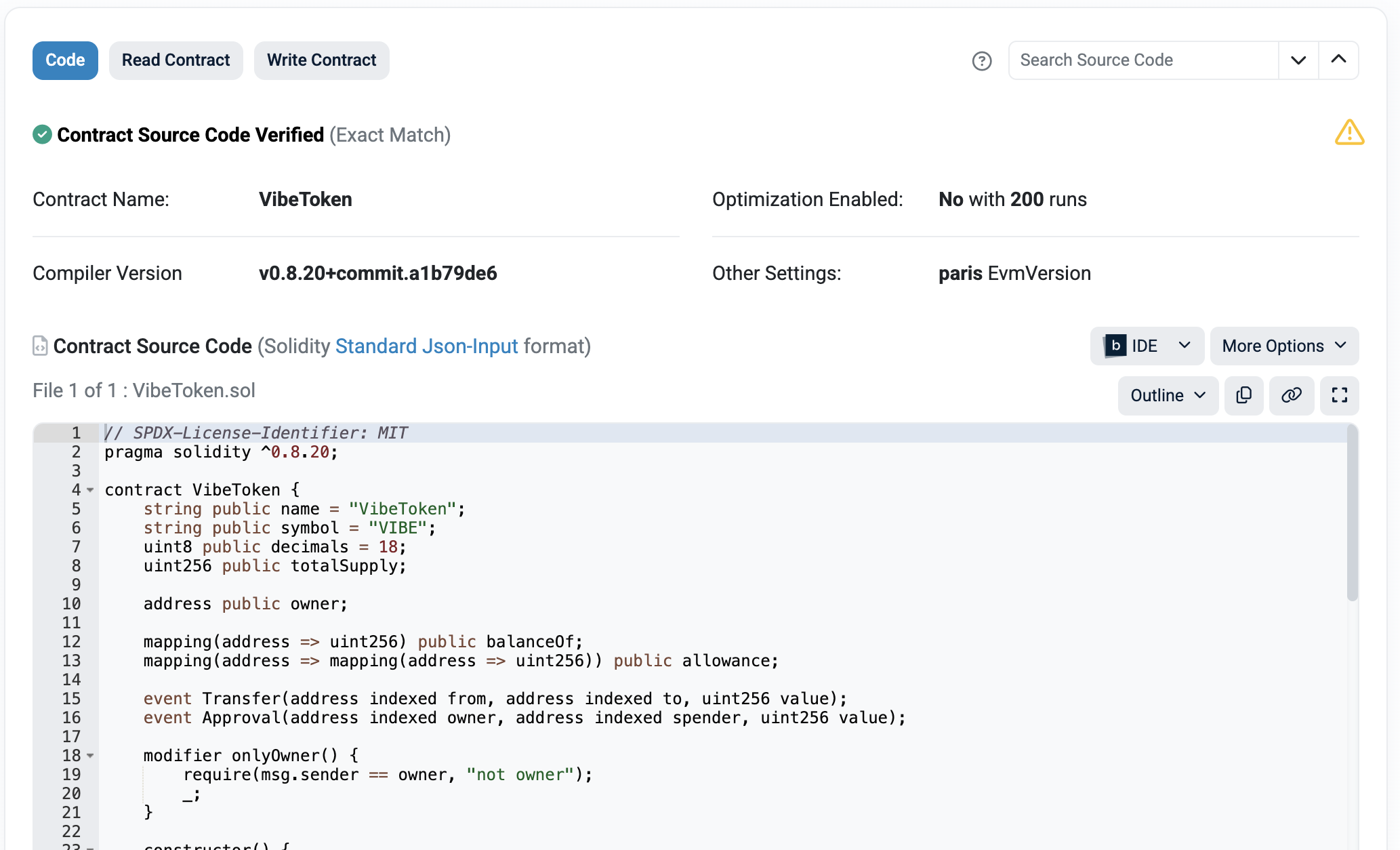
The testnet-first workflow paid off. By the time I touched mainnet, every step had already run successfully. The only surprise was a Hardhat bug where the ethers.js transaction formatter choked on a contract deployment response (the to field is empty for contract creation transactions). The transaction went through fine — the error was in the post-deploy parsing, not the deployment itself.
Minting and Burning On-Chain
The contract has mint and burn from the start, but I hadn’t actually called them on mainnet. A Hardhat script makes this easy:
const AMOUNT = ethers.parseUnits("1000", 18);
const tx = await token.mint(signer.address, AMOUNT);
await tx.wait();
Running this on mainnet:
Total supply before: 1000000.0 VIBE
Minting 1000.0 VIBE to 0xf8C4...C653...
Total supply after:  1001000.0 VIBE
Then burning it back:
Total supply before: 1001000.0 VIBE
Burning 1000.0 VIBE from 0xf8C4...C653...
Total supply after:  1000000.0 VIBE
A few things are worth noting. mint is onlyOwner — only my wallet can call it. burn is unrestricted — anyone can burn their own tokens. Both emit a Transfer event: mint from address(0), burn to address(0). That’s the ERC-20 convention for tokens appearing out of nothing or disappearing into nothing.
The total supply tracks correctly. But my wallet balance is 990,000 VIBE, not 1,000,000 — because 10,000 VIBE is locked in the Uniswap pool. The contract doesn’t know or care about Uniswap; it just sees that address holding tokens.
Building a Landing Page with Live On-Chain Data
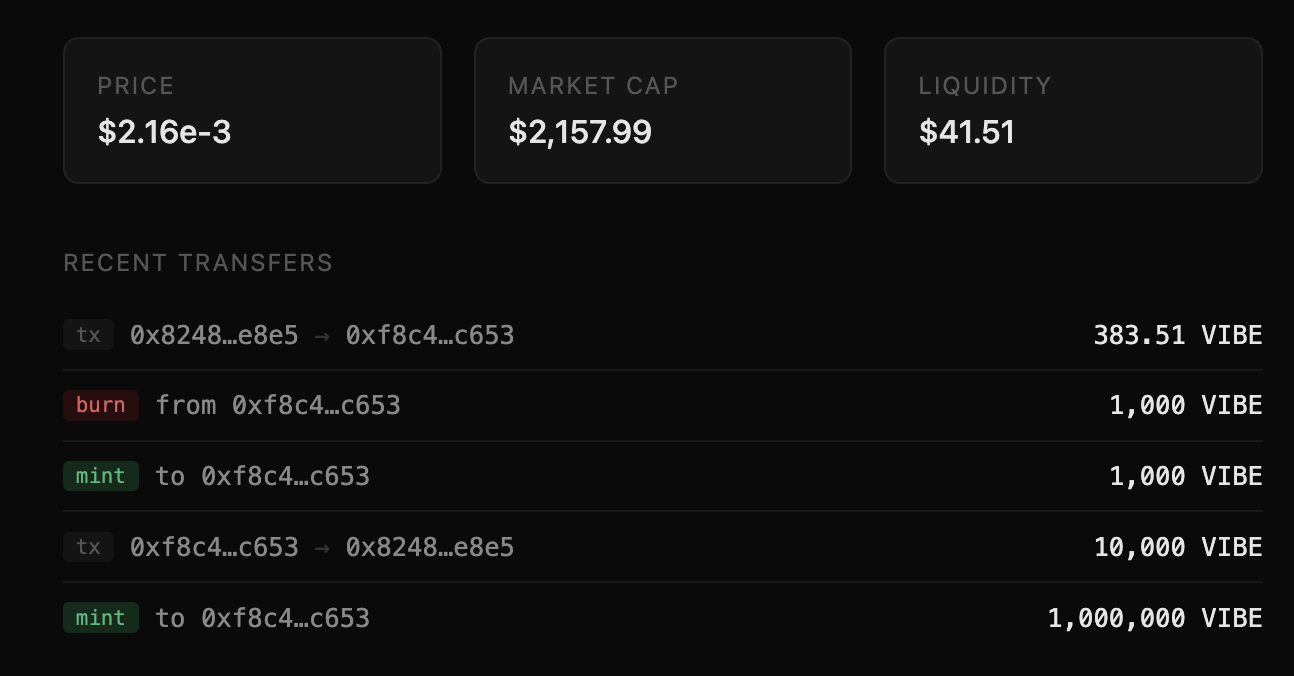
I built a landing page at thevibetoken.xyz — a single HTML file deployed to Netlify. The interesting part was getting live price, market cap, liquidity, and a transfer feed without paying for any APIs.
Getting the Price
My first attempt used the Uniswap v3 subgraph via The Graph’s public gateway. It returned {"pairs": null} — the pool was too new and too thin to get indexed. The Graph also deprecated its free public endpoints, so this was a dead end regardless.
The right approach: read directly from the contracts. No indexer needed.
Price comes from the Uniswap v3 pool’s slot0() function, which returns the current sqrtPriceX96 — a fixed-point representation of the square root of the pool price. Converting it to a USD price takes three steps:
- Call
factory.getPool(VIBE, WETH, 3000)to get the pool address - Call
pool.slot0()to getsqrtPriceX96 - Compute:
price = (sqrtPriceX96)² / 2¹⁹²— this gives WETH per VIBE (both tokens have 18 decimals, so the decimal factors cancel) - Multiply by ETH/USD from the Chainlink price feed at
0x5f4eC3Df9cbd43714FE2740f5E3616155c5b8419
In vanilla JS using BigInt:
const sqrtPriceX96 = BigInt("0x" + slot0.slice(2, 66));
const priceETH = Number(sqrtPriceX96 * sqrtPriceX96 * 10n**18n / 2n**192n) / 1e18;
const ethUSD = Number(BigInt("0x" + chainlink.slice(66, 130))) / 1e8; // 8 decimals
const priceUSD = priceETH * ethUSD;
Liquidity is just the WETH and VIBE balances of the pool contract, converted to USD.
All of this over a public RPC — I ended up using 1rpc.io after Ankr and LlamaRPC both required auth.
Getting the Transfer Feed
The Transfer event is emitted on every mint, burn, and transfer. eth_getLogs fetches them:
{
  method: "eth_getLogs",
  params: [{ address: VIBE, topics: [TRANSFER_TOPIC], fromBlock: "0x...", toBlock: "latest" }]
}
The catch: 1rpc.io caps eth_getLogs at 10,000 blocks per request. The contract is ~16,000 blocks old. So I paginate — fetch in 9,000-block chunks in parallel and flatten:
const chunks = [];
for (let from = DEPLOY_BLOCK; from <= currentBlock; from += LOG_CHUNK) {
  chunks.push(fetchLogChunk(from, Math.min(from + LOG_CHUNK - 1, currentBlock)));
}
const logs = (await Promise.all(chunks)).flat();
Parsing a log: topics[1] is the from address, topics[2] is the to address, data is the amount. Mint events have from === address(0), burns have to === address(0). The page color-codes them accordingly and links each row to Etherscan.
The whole thing is ~100 lines of vanilla JS with no dependencies. It polls every 30 seconds.
What I Actually Learned
The mental model shift: a smart contract is a program that lives at an address on a shared computer. The EVM is that computer. Every Ethereum node runs it. When you deploy, you’re uploading bytecode to a permanent address. When someone calls a function, every node executes it and agrees on the result.
Tokens aren’t stored anywhere special. There’s no token registry. The “balance” is just a number in a mapping inside a contract. MetaMask knows you own VIBE because it calls balanceOf(yourAddress) on the contract and displays the result.
Gas is payment for computation. Every opcode costs gas. The deployment transaction includes the contract bytecode, which costs more gas than a simple transfer because there’s more data. Miners/validators won’t run your code for free.
The owner pattern I implemented is primitive — a real contract would use something like OpenZeppelin’s Ownable with ownership transfer and renouncement. But I now understand why that pattern exists, which I wouldn’t if I’d started with the library.
The code is at github.com/korbonits/vibe-token.
What’s Next
This project is a learning exercise, not a production token — but here’s what I’d do before treating it as one, in roughly priority order:
Renounce ownership. The contract has a mint function gated by onlyOwner. As long as I hold the owner key, I can inflate the supply at will. Adding a renounceOwnership() function and calling it on-chain would permanently disable minting — verifiable by anyone on Etherscan. This is the single highest-trust signal a token can give.
Lock the liquidity. I own the LP NFT from Uniswap. Nothing stops me from removing all the liquidity tomorrow. Services like Team.Finance or Unicrypt let you deposit the LP NFT into a time-lock contract — provably unable to withdraw for a set period. Without this, any liquidity pool is a potential rug.
Concentrate the liquidity. I used full-range liquidity (equivalent to Uniswap v2). Uniswap v3’s concentrated liquidity lets you deposit within a specific price range and earn a larger share of fees from trades in that range. More capital-efficient if you have a view on where the price will trade.
Use OpenZeppelin. Now that I understand what the contract does line by line, using OpenZeppelin’s audited implementations is the right production move. ERC20.sol, Ownable.sol, ERC20Burnable.sol — all battle-tested, all composable. I avoided them here deliberately to see the internals; I wouldn’t avoid them in production.
If you’re following along and want to go further, start with renouncing ownership — it’s one function call and immediately makes the token more trustworthy to any outside observer.