Journaling vs Meditation vs Writing
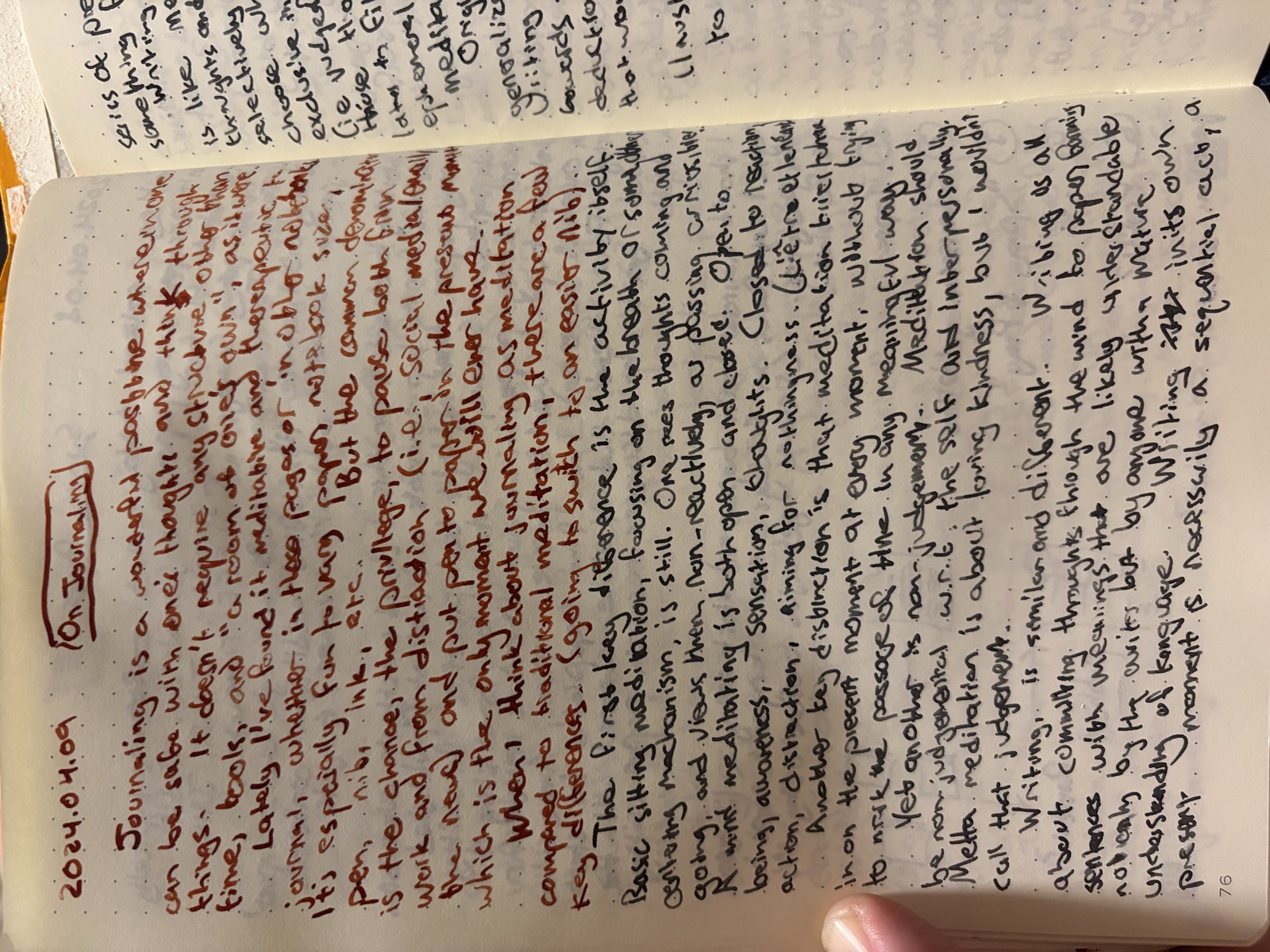
Switched to red ink for this entry, which I take as evidence that I wanted to mark it as a different kind of thinking than the technical pages it sits between. The post is a transcription of the distinction the page is reaching for.
My classic rolltop desk has three things on it (other than piles of books on top and drawers stuffed with old notebooks, ink, and pens): a Leutchtturm notebook open to a blank page, a foundtain pen, and a closed laptop. I sat quietly for about ten minutes before I came over here. The question I keep failing to answer cleanly is: of the three things I just did or am about to do — sit, write, journal — which one am I doing right now? They look the same from the outside. They feel similar in the muscles of attention. But the demand each one makes on me is different, and the failure mode of each is different too, and I keep mixing them up.
This is an attempt to draw (or write) the lines.
The real axis is goal-directedness
The notebook entry this post is built on started as “journaling vs writing” — a binary — and ended a page later with the realization that they’re more synonymous than I’d thought. Both involve attending to the page; both involve selecting what to put on it; both produce artifacts. The honest distinction isn’t between them. It’s between practices that have a goal and practices that don’t.
Three practices, sorted by where they land on that axis:
- Meditation has no goal. Or rather: the absence of a goal is the goal. You sit, you attend to the breath, thoughts arise and pass, and the practice is not to do anything with them. Trying to get something out of meditation is the most reliable way to fail at it. Ohm.
- Writing has a goal by definition. The writer chooses what goes on the page in service of something — persuade, explain, entertain, settle a question, sell a thing. Selection is the central act. The page is an instrument. Writing is thinking.
- Journaling sits in between, and which way it leans is a per-session choice. Some sessions are goal-directed (work something out, decide a thing, draft a passage). Some are capture (catch a thought before it leaves, mark a moment). Most are both. The practice is choosing, page by page, which it wants to be — and tolerating the ambiguity instead of forcing it into one of the other two boxes.
Attention budgets
The cleaner way to read these three is by what each one asks of my attention budget:
- Meditation spends attention on the present moment and asks for nothing back. Output: zero artifacts. Inventory: a slightly clearer mind.
- Writing spends attention on the artifact and asks me to subordinate the present moment to it. Output: a finished thing. Inventory: a draft.
- Journaling spends attention on the present moment and leaves a residue. Output: a page that wasn’t planned. Inventory: a record of what you were paying attention to before you knew it mattered.
That’s the shape. The activity (sitting, typing, longhand) is incidental. What matters is what the practice is asking your attention to do, and whether it’s asking for an artifact in return.
Why mixing them up matters
Most advice about “writing every day” conflates these. Morning pages are journaling, not writing. Bullet journaling is record-keeping, not journaling. A lot of meditation-app journaling prompts are therapy, not meditation, and not really journaling either.
Knowing which one you’re doing matters because the failure mode of each is different:
- Failed meditation = constant grasping at thoughts (which is just thinking with extra steps).
- Failed writing = no editing, no shape, no audience, no point.
- Failed journaling = either becomes therapy (if too goal-directed) or becomes meditation that someone wrote down (if not selective enough).
The most common failure I make personally is mistaking failed writing for successful journaling — using the notebook as a place to grind on a draft because the laptop felt too judgmental, then ending the session disappointed that the draft isn’t done. The session was fine. I just labeled it wrong.
korbonits.com is my personal blog. I write about ML, software, and books.