A Room of One's Own, in a Bleak House
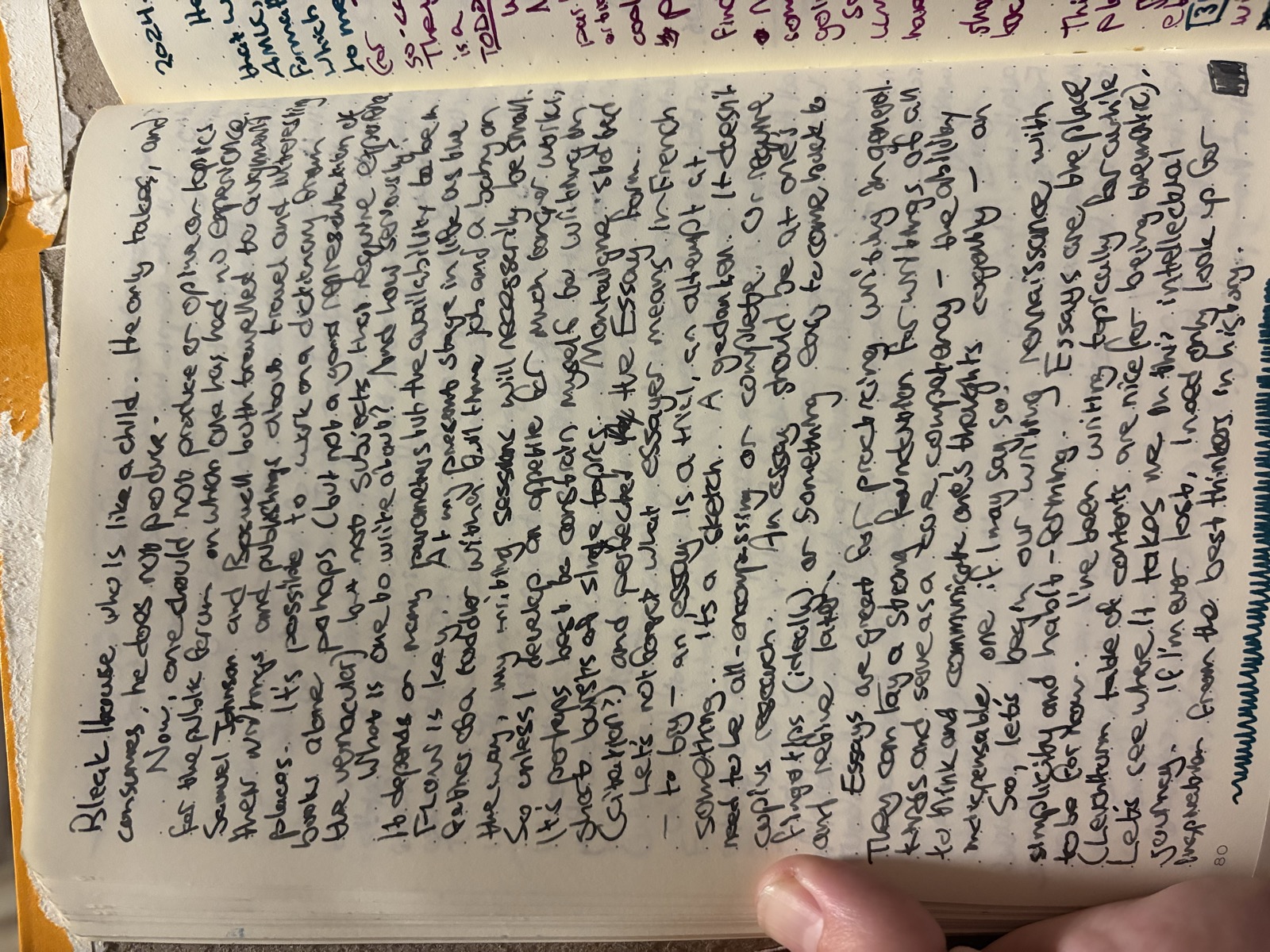
The page that gives the post its title. The handwriting is denser than the surrounding entries — me trying to keep up with a thought that almost got away. The flow itself is part of the argument the post is making about why this medium produces different writing than a word processor.
Between 2018 and 2024 I read a lot of books about writing. Strunk and White. Anne Lamott. Stephen King’s On Writing — still one of my favorites. Annie Dillard. The classics, the recommendations, the ones everyone tells you to start with. I made it through about half of the stack, underlined as I went, recommended them to other people in turn.
I also wrote, but not often. A draft here, a started essay there, nothing finished.
The notebook I’m writing this post in has carried more of my actual writing than any of those books, however good, ever produced for me. That’s not their fault. Reading about writing isn’t writing. That’s the thing I want to talk about.
The thread
Three movements in the original notebook entry:
1. Personal history of trying to write
A long, intermittent stretch between 2018 and 2024 in which the buying-of-books and the actual-writing never quite kept pace with each other. About half the writing books got read; the writing itself happened occasionally — a draft here, a started essay there, nothing finished.
The decisive change was that we became parents — first in 2023, then again in 2024. Between full-time work and two small kids, “discretionary cycles for writing” stopped being a phrase that mapped to any actual time on the calendar. The shape of the lapse, especially in the back half of that stretch, is the shape of two competing constraints — both real, both non-negotiable, neither of them the books’ fault.
2. Word processors made everything worse
The modern circumstance of word processors — but the temptation to fix everything you create as you create it requires you to be more standard … by hand compels you to be more standard, stay edited, and rewrite later.
Writing by hand forces a different relationship with the sentence. You can’t go back and tweak the third word of paragraph two without copying the whole thing over. So you don’t. You commit, you keep going, you fix it later, somewhere else, on a different surface.
3. Bleak House — who is the public?
The killer frame, on page 7041:
Bleak House: who is the public? … One should not produce just for the public … there are some people, too, with whom one has not the desire to converse or trust.
I’m summoning Dickens here on purpose. Bleak House (Charles Dickens, serialized in nineteen monthly numbers — the last a double issue, totaling twenty installments — by Bradbury & Evans between March 12, 1852 and September 12, 1853, then bound as a single volume the same day as the final issue) is the canonical example of writing-for-the-public as a job. Dickens wrote each installment under deadline, knowing exactly how many readers had bought the previous one, knowing the cover price, knowing which characters had landed and which hadn’t. The serialized novel is the most market-disciplined form of fiction in English literature.
And yet the question the notebook is asking — who is the public? — is the question Dickens was secretly asking too, behind the deadlines. Not everyone. Not the people he didn’t trust. Even the most public-facing writer in the language had a real audience inside the imagined one, and the real audience was much smaller and much more specific.
The point isn’t that you should write for nobody. The point is that “the public” is not a real audience. Real audiences are: yourself in five years, three specific friends, a stranger who is exactly the person you used to be. “The public” is a fiction that, when treated as the audience, produces a fiction-shaped writing — and even Dickens, of all writers, knew this.
A room of one’s own, restated
The canonical version of this argument is Virginia Woolf’s A Room of One’s Own — published September 28, 1929 by the Hogarth Press in London and Harcourt Brace in New York, developed from two lectures she gave the previous October at Newnham College (October 20) and Girton College (October 26) at Cambridge. Woolf’s thesis is that “a woman must have money and a room of her own if she is to write fiction.” It’s an argument about material conditions: without privacy, without economic independence, without the literal physical space to close a door and think, fiction by women cannot exist.
The argument I’m reaching for in the notebook is downstream of Woolf’s, in a register she didn’t need to address because the technology hadn’t created the problem yet. Once you have the room and the money, you still need:
- A room from the imagined public. The internet made every act of writing implicitly addressed to an audience of strangers. That audience does not exist; what exists is your projection of it, which is not the same thing. Writing toward the projection produces writing shaped like the projection.
- A room from the word processor. Infinite revision is not a feature of writing; it’s an absence of constraint. A page you can re-edit forever is a page that resists ever being finished.
- A room from the feed. Social media is not just a time sink; it is an ongoing low-grade rehearsal of who you are for other people. Spending hours per day in that rehearsal makes the private voice harder to hear.
Woolf wanted a room with a door. The 2024 version is a notebook on a desk with the phone in another room. Same essay, different lock.
What this post is actually about
It’s not “write by hand, it’s better.” That’s the surface story.
It’s about the relationship between the technology of writing and the imagined audience of writing. When you write by hand for yourself, the audience is real (you), the medium is honest (paper doesn’t lie about what you wrote five minutes ago), and the constraint is productive (no infinite revision).
When you write on a word processor for “the public,” the audience is imaginary, the medium pretends every revision was the original thought, and the constraint disappears.
The Renaissance of writing — long-form essays, Substack, blogs — is, to a first approximation, people rediscovering that the audience part of writing was the broken thing, not the prose part. Woolf’s room, restated for a generation that has the room and the money but not the silence.
korbonits.com is my personal blog. I write about ML, software, and books.